Friday, February 7, 2014

Tattered Fig Leaves - Christian Tribalism and Sexual Abuse


Our Tattered Fig Leaves

Christian Tribalism and Sexual Abuse


            There are whispers, even investigations, of patterns of sexual harassment and abuse.  There are whispers of sexual harassment at Christian universities that instead of being dealt with are covered up.  There are the stories of respected figures involved in patterns of sexual relationships, such that most of humanity would object to what is happening.  From most Evangelicals' perspective, these things would be wrong even if the relationships were consensual.  But many of the stories being told are not what we would consider consensual.  There are older trusted persons using "Christian counseling" to take advantage of a minor.  Or there may be patterns of harassment at a university where the institution would rather keep the problem secret rather than sully their institutional reputation by acknowledging a problem on campus.

            Christians in our era are divided among many groups, and often we doubt a different group's Christianity.  We are tribal, perhaps we have divided into warring clans.  We hear of another tribe or clan's problems and convince ourselves that the problem is a problem for that other tribe within Christendom.  If Catholic priests have been guilty of sexual molestation then it is because they are Catholics and don’t have good Evangelical doctrine.  If a Charismatic group has a problem, it is because they don’t have solid Reformed doctrine shaping their communities.  If a Reformed church has a problem it's because those Calvinists are always so legalistic.  But the truth is we imagine that if we have just the right doctrine, right tradition, right view of the Holy Spirit, then it makes us immune from the temptations that are common to mankind.  We could take any of my sentences and substitute different names and we'd all imagine that our group has an immunity from certain sins.

            Perhaps because we imagine that if we have the right doctrine certain sins won’t plague us we are set up for a worse problem in each of our tribes.  If we imagine that we are excluded from a certain sin, perhaps we will boast about our holiness, and the Gospel we preach will not just be about the Gospel of Jesus Christ, but it will be here is the Gospel and you can see it wonderfully expressed in our particular group which is why you need to come to our particular church, Christian university, or participate in our Christian ministry.   We will assume that we are just a bit better than the rest of everybody else.  But what happens when despite all our advantages that sin we didn't think would ever be our sin shows its face in our midst?  We will be tempted I suspect to try to keep its presence quiet because in our prayers and praises we have humbly cried out in our temples, “Thank you Lord you have not made me like other men.”  But suddenly there is in our midst sins that make it seem like we are like other men.  At that point we will be tempted to keep it quiet for the sake of our institutional testimony.

            I am not suggesting that every sin needs to be broadcast.  We should desire during an occasion of sin that because love covers a multitude of sins that a quiet repentance might take place in which no one is necessarily covered with shame.  But that covering of sin is a far different situation than when a college or Christian ministry is accused of having a pattern of sexual harassment or abuse, that the institution or ministry seeks to cover the problem for the sake of institutional reputation.  When someone is being violated by patterns of sexual harassment or abuse, then the Christian institution should clearly desire to support the abused above maintaining its own reputation.  When accusations of abuse are brought forward the accusations should be given their due, should be investigated and reputation should be secondary to insisting upon a merciful justice that upholds those who have been violated.

            One of the institutions with a respected leader in some circles is Bill Gothard.  Here is a recent blog asking for a thorough investigation of Bill Gothard.  Gothard’s ministry, from my perspective, shows how institutions, with people seeing all sorts of abnormalities, will excuse the abnormal appearances based on a belief that our spirituality is above that of other people.  When an accusation is raised against the leader, the followers circle the wagon even when some things out of the ordinary become obvious after the fact.  We resist wanting to believe about the leader of our tribe or clan, what we might well see written all over the leadership of a clan or tribe foreign to our perspective.  People on Gothard’s staff knew he spent a lot of time with young girls in counseling, but I suspect that because they believed they had some of the best teaching on dealing with sin, they could not entertain the possibility that anything wrong was taking place behind the pattern of closed doors with teenage girls.  There was a circling of the wagons around their leader.  This is not a problem strictly religious.  The movie "Downfall" showed secretaries working closely with Adolph Hitler.  One from the city of Munich said she never saw herself guilty of anything done by Hitler until she saw a plaque honoring Sophie Scholl, who was born the same year as she.  She then realized that if she had asked questions, pondered over statements she heard, she would have seen what Sophie Scholl saw but she chose rather not to see.  According to one group intent on seeing Gothard’s practices curtailed there are now 34 women who have come forward against Gothard’s dealings with them.  It is in the least time for a thorough investigation.

            For the past couple of years Bob Jones University has had an ongoing investigation into a pattern of sexual harassment on the campus.  They asked an independent Christian organization to investigate the complaints and file a report.  The independent organization promised confidentiality until the report was completed at which time the findings would be made public.  As the investigation was moving into its final stages, Bob Jones University released or fired the investigators.  Since the investigation was not complete the independent organization will not be able to speak on their findings.  Bob Jones University has commented that it has made substantial changes in school policy and therefore the investigation in their eyes is no longer needed.  This article describes the abrupt dismissal of the investigators.

            Here are the lessons I think we should learn from these fiascoes.  First, let us realize that every temptation we undergo is common to humanity.  Our doctrine, our denominational structure, our gifts of the Holy Spirit, and our tradition do not exempt us from the temptations common to man.  I can recall how as one who was a naïve Evangelical I would read the Epistle of Ephesians and see that some of the sins mentioned among the Corinthians didn't seem to be mentioned among the Ephesians.  I imagined that meant that the Ephesians had it together so well that they didn’t have the problems the Corinthians had.  But in reality St. Paul prophesied to the leaders of the church of Ephesus as recorded in Acts 20:24-31 how some from within their church would lead many astray.  The church at Ephesus seems almost ideal in the epistle written to it, but not in Acts, and not in the Book of Revelation.  The Ephesian church, if it boasted at how much better it was than the Corinthian church, evidently had it all wrong.  The truth taught to us in the Bible and perhaps especially in the New Testament is that real temptations come upon the people of God and real sins plagued the church and this is true no matter how impressive our tradition, our doctrinal confessions, our view of the Holy Spirit, or anything else we believe gives us a special right in which to boast.

            So we need to take into account that we have no guarantees that what we have in our particular spiritual package makes us immune from sin.  There are no easy vaccines to give to God’s people wherein the plague of sin will no longer be able to reach us.  We seek instead a sensitivity for our nearness to sin, and a desire to see those violated by sin healed and dealt with faithfully, and a desire that when one has fallen into a sin that they would be dealt with in a way that may show them how to escape being overcome by that sin.  None of this is accomplished by hiding sin so as to maintain a ministry's reputation, but rather this is accomplished by acknowledging sin at whatever level necessary to encourage healing and restoration both for the victim and the offender when possible.

            We should learn to accept that among human beings there will be many diverse sins.  That does not make a church ministry illegitimate.  But when a church or ministry chooses to cover up how a person’s humanity has been violated under their watch because it doesn’t want its institutional reputation sullied, then that ministry is rapidly descending towards illegitimacy.  If we are to take these horrendous violations of humanity seriously then we must insist that our churches and ministries recognize that sin is a part of Christian community life on this side of eternity.  We must also make clear that hiding sin to maintain a façade of reputation among men is never a legitimate way of ministering on behalf of the people of God.  We must demand nothing less than a cultural shift within our churches and Christian ministries away from protecting institutional reputations, and towards encouraging the healing of human beings violated by sin as well as the restoration of sinners guilty of violating their brother or sister.  No institution involved in Christian ministry is any better than its failure to provide for its weakest brother or sister.

Saturday, February 1, 2014

Seeing our Bodies # 5 - Eating the Forbidden Fruit


Seeing our Bodies

Part 5 – How are we to understand the eating of the forbidden fruit?


Partaking of the forbidden fruit, expulsion from Eden
Michelangelo’s painting in the Sistine Chapel


            It would seem that there is mystery involved in the Genesis account of mankind’s fall into sin.  Whether one takes this story as the factual occurrence, a literal historical account, or as God’s story describing what took place in a way in which we can understand the story and its implications for all of us, the story has mysteries not easily explained.

God made it clear to Adam and Eve that they were not to partake of the fruit of the tree of the knowledge of good and evil.  The Serpent suggested there was more to this command than God was letting on.  The Serpent told Eve “God knows when you eat of it your eyes will be opened, and you will be like God, knowing good and evil.”  This would be an easy enough story to understand if the story showed us in a clear-cut way that God was truth telling and the serpent was deceiving.  But deception seldom works by telling a simple lie.  Deception speaks truth aimed at hiding a significant element of the truth.  Deception is a confidence scheme using some truths as a hook to win one's confidence until the scheme has them sucked in.  The serpent was accusing God of a confidence scheme, of holding back something important from Adam and Eve.  When the story is told there is enough truth in the serpent's words to make us wonder because God acknowledges that in some way Adam and Eve had become like God able to distinguish good and evil.  There is mystery involved here, but there is enough of this story that when taken with the rest of Holy Scripture we can begin to see how the serpent was a deceiver, and how the gaining of an ability to distinguish good from evil did not necessarily give us much of an ability to redeem ourselves from a fall into sin.

Many a reader of the Biblical account is taken back by how the serpent seems to express more about what the forbidden fruit would do for Adam and Eve than God's simple command not to eat of the forbidden fruit had indicated.  So when Adam and Eve do eat of the forbidden fruit we would perhaps expect the story to explain that the serpent's promise was all a lie.  But instead God banishes Adam and Eve from Eden while saying “Behold, the man has become like one of us, knowing good and evil; and now, lest he put forth his hand and take also from the tree of life, and eat, and live forever” - - therefore the LORD God sent him forth from the Garden of Eden, to till the ground from which he was taken.” (Genesis 3:22-23)

There is a mystery of what took place in this transaction, but it seems to me that a couple of explanations perhaps make some sense of the story in a way that relates to what we are elsewhere given in the Scriptural teachings regarding the nature of man.  The serpent is a deceiver because he failed to tell them that this understanding of good and evil would come with a price tag.  That price tag would be that they would have knowledge of good and evil not as innocent persons having done neither good nor evil, but as transgressors having become sinners.  Adam and Eve gained an understanding of good and evil and became like God in that sense of understanding or sensing the distinctions between good and evil, but that understanding was an understanding twisted and turned by man’s fall into sin.  I think S. Bruce Narramore in his work No Condemnation perhaps has understood what happened in this transaction as well as anyone I have read.  Adam and Eve obtained through their partaking of the fruit an autonomous conscience functionally capable of distinguishing through reason the distinction of good and evil.  But this autonomous (rooted in our own individual beings) function had come to be as we fell into sin.  So from the beginning, not quite like the serpent told it, Adam and Eve had not only a conscience through the transaction, but a defiled conscience through the transgression.
 If we read the Bible carefully regarding our human consciences we will discover that they are not necessarily speaking divine truth.  There are those as Narramore carefully pointed out in his book that had well informed strong consciences.  There were those who had weak consciences wherein people feel condemned in a certain action that is not actually a sin whatsoever.  Then there are those who have seared consciences that have been silenced and reshaped so that they do not sound an alarm when sin is near or when a transgression is committed.  Narramore was concerned that too many Christians viewed conscience as a wholly divine voice within human experience rather than an autonomous conception of good and evil that was not only acquired in what is described as the original transgression against God, but has a tendency to try to work out salvation in a human manner separate of God's work of redemption.
That is what we see Adam and Eve trying to do in Genesis 3.  They see that they are naked and they make garments to cover their nakedness, a nakedness perhaps itself representing that they are no longer whole persons wholly integrated within God's creation.  They are instead defiled creatures needing a covering.  But the autonomous nature of conscience drives Adam and Eve to seek ways of clothing themselves, and of hiding themselves from God.  This is the very opposite of what we will be taught through the Gospel.  We are told in the Scriptures that he who covers his transgression will not prosper.  But Adam and Eve make for themselves garments from the fig leaves and hide themselves when God speaks.  The Gospel describes for us the need to confess our sins and to receive forgiveness and to be healed through God's provision of redemption.  But conscience will often lead us to try to cover our sins, to make up for evil with trying harder, and with some other way than looking to God for his provision of forgiveness and discipleship through his word, his Spirit, his church, and his people for restoration and sanctification.
For this reason Narramore became convinced that there were many ways in popular Christian teaching that Christians were being driven not to the Gospel for restoration from sin but to our own human consciences.  The human being confronted by his conscience can be driven to a remorse for sin, but as long as it is only a human conscience directed dealing with sin will always be trying to work harder to overcome the fault and will be characterized by hiding, by shame, and by a sorrow that falls short of repentance.  But the Gospel directs us away from an autonomous work of salvation directed by our individual consciences.  It describes a redeemer who has come into the world, taken his place in our lives by becoming God with us, and taking on human flesh in the incarnation.  He who has done this has made himself manifest to us in the life of Jesus Christ and has expressed an invitation as he says to us, "Come, follow me."  He is committed to being our Savior, our Redeemer, our teacher, our great high priest, the lamb sacrificed for our sins and the risen Lord capable of instructing, teaching, and discipling us not from the sense of guilt taught to us by our consciences but by the certain success of his resurrected life and eternal power, the proclamation of His Holy Word, and the guidance of the Holy Spirit to the pleasure of God the Father.
We sometimes read in our days of dressing in accord with purity codes.  But we need to watch carefully that we do not put on the clothes of an awakened but autonomous conscience like that which Adam and Eve wore when they saw themselves as naked and so put on the garments they made from fig leaves.  Instead, we are to wear those garments made for us in the life and righteousness of Jesus Christ.  These are garments made for us by the love of God and wrapped around us without shame or deceit in the promise of salvation.

Sunday, January 26, 2014

Seeing our bodies #4 -Fig Leaves


Seeing our Bodies

Part 4 – Fig Leaves shame and separation


  1. The Torn Veil

            I’ve been struggling to write about this portion of the story of Adam and Eve when Adam and Eve envisioned their bodies after they had partaken of the forbidden fruit.  I do not believe that I communicated well what I hoped to communicate through the blog I did on Adam and Eve seeing their bodies naked and yet being unashamed in the beginning.  Perhaps I should have written with greater bluntness.  What if the whole of creation was the original intended temple, a temple where everything in it was a display of the honor and glory and attributes of the invisible God?  What if we were originally created especially and specifically to be physical expressions of the image of God in this specially created physical universe?  What if when we were naked and ashamed it meant that we by nature communed with God in our communion with one another and with creation?  What if when we transgressed that one command we defiled chiefly ourselves but desecrated the temple and created separation?  Would the clothing we made for ourselves be an unconscious veil describing how now we were separated from creation, from one another, from God, from the holy of holies?  Could it be that garments made by human hands, sewn from fig leaves in desperation after seeing your nakedness only serve to reveal the separation between you and everything in the original created temple of the universe?  Would all future temples merely be symbolic copies of how creation had been intended to be celebrated in the worship of God?  Would future temples be provisions of God to show us the way back to where it will be in the end as it was in the beginning when heaven is brought into union with earth and no man will say this is the mountain of the Lord, but every place will be the place where those who worship in spirit and truth worship the Lord?  I didn’t convey that very well.  So maybe it doesn’t seem to some that when a child takes the reins of a horse in hand and gallops across a field enjoying the power of the horse and the partnership with a horse there is a sense that one enjoys God for one can realize that God is the author and sculpture and painter who brought life to all.

            I’ve been delayed writing this blog.  I’ve been delayed wanting to write something not having to be changed after posted.  I’ve wanted to make sure not to serve the wine before its time.  But also I have been feeling miserable from a cold and the patent medicines I take for my cold.  I am reminded of what a Russian once told me about colds.  The Russian said “In my country we have a saying, if you take no medicine for your cold you will have a cold for seven days, but if you take medicine you will get rid of it after only a week.”  Sometimes with colds I feel the Russian was right.  I wonder if that is why Adam and Eve decided to make fig leaves when they saw they were naked, when they knew they had transgressed, and knew something was not right in their universe.  They were ashamed, and like me with a cold they wanted to feel like they were doing something to solve the problem.  So they made garments from fig leaves.  There was at least another thing going on with Adam and Eve after they ate of the fruit of the tree of the knowledge of good and evil.  I will save the second part for another blog to follow this one.  But they felt naked, felt the need for clothing, for a veil to separate themselves from the creation, from each other, between them and God, between them and the holy of holies.  When they heard the voice of the Lord they hid.  They hid not to separate themselves from God, but because in their transgression they had already separated themselves from God.

            These garments made of fig leaves magnify our separation.  Let us consider how we were separated:

            We were separated from the liturgy of creation.  This is what much of modern man misses about the creation story.  So much emphasis is placed upon the power of the fiat word of God, when God says “Let there be” that so few realize that these are words of a creative liturgy to which the creation sleeping full of potential energy awakens and responds.  God said let the earth bring forth vegetation, and the earth responds and brings it forth.  In the evening of each day of creation God looks at the response of the universe and he declares what he sees as good.  There is a liturgical relationship through which the universe at first a void shapeless darkness is brought to light, life, beauty, and order.  It is the work of liturgy through which the creation takes shape.  But we who were created to especially show the image of God and must be most free are given a single command to follow and to not do.  It is a part of the liturgy.  We transgress and separate ourselves from the liturgy of God speaking to his creation.

            If you have looked very often at what the Bible describes as hell, it is most similar to the created existence prior to God’s liturgical formation of the creation in those six days of creation.  Jesus described the place of eternal punishment as the outer darkness.  It is the place where everything with shape and order is broken down.  One passage either a part of Mark in the original that was lost or a portion inserted at a later time describes how the worm does not die and the fire is not quenched.  There are problems with this verse from a textual consideration, but they present a similar perspective to the nature of punishment described by Jesus in being cast into the place of outer darkness. {see note at end}  If we persist in refusing to hear the words of grace then we shall be granted our desire to have a life separated from the liturgy of God’s creation and we shall gradually retreat into the darkness of the chaos that was before God began to speak to the creation.  It is a frightening scene that is described when given the chance to repent men and women call for the rocks and mountains to fall upon them.  While this is not the main story set before us in the Gospels it is part of the story told in the Gospels.

            But for those of us who have begun to hear the liturgy of Christ we live in a world recovering from the tragedy of those days.  We understand the separation by what we feel needs to be overcome in ourselves.  We feel the sense of separation with the world in which we live.  This present earth is as much a display of the bloody red claw of survival as it is of the beauty and glory of the attributes of the invisible God.  This creation is a temple defiled.  We struggle to find common ground with men and women in varied relationships, whether formal, of informal, familial living under the same roof or strangers meeting in a narrow aisle in the store; or husband and wife trying to make a connection when they have each experienced days putting them out of joint.  Then there is God, and how many are the times when he would call to us, that we hide from him in a thousand pursuits?  I suspect after they had transgressed Adam and Eve saw they were naked and felt the separation from everything and so put on clothes hoping as an old song may have put it to hide from others the emptiness felt inside.
            “We drank a toast to innocence
              We drank a toast to now
              And tried to reach behind the emptiness
              But neither one knew how.”
Dan Fogelberg, 1980. “Same Old Lang Syne”

{Denise, a well-informed reader pointed out the disputed text is a quote of the final verse of Isaiah, so Biblical for all concerned}

Wednesday, January 22, 2014

Seeing our Bodies - Part 3 Naked and Unashamed


Seeing our Bodies

Part 3 – Naked and without shame in a Very Good Creation
 

{An image of Adam and Eve should go here, but they all looked so European;
And how can two Europeans work as an image expressing the origin of all humanity?}
 

            I had it all figured out what I would say about Adam and Eve, freshly created, aware of creation, of one another, of God, being both naked and unashamed.  I had it all figured out but then I realized all I was doing with what I had thought to say was to write what would amount to being a remake of a common Protestant script about how man was flawless and then fell into sin, and so we lost that original state.  I decided I shouldn’t try to rewrite “Paradise Lost” in a blog.  If you wish to read “Paradise Lost” don’t bother with a blog, let Milton speak to you in his originality.  Then this morning I saw an article someone posted on Facebook describing the beauty of “story.”  Jennifer Percy described in this Atlantic Monthly article how she switched her university major from Physics to Literature because she began to see literature as a more satisfying way to approach and consider life’s complexities.  A narrative, because it tries to express human life captures a scene where the complexities of human life and human characters are caught up in a moment.  The scene that is framed is complex because human life can be understood in many ways looking on a single expression of human life.  Milton and Protestantism have captured a relevant perspective concerning the story of Adam and Eve, but there is more to the story.  There is always more to a human story.

            I gradually remembered I was drawn to write about Adam and Eve’s ways of looking at themselves because of a heart wrenching letter written by a thirteen year old girl.  I am Protestant enough to acknowledge that even thirteen year old girls have sinned in some way or another.  But to try to immerse a thirteen year old girl’s perception of herself as “fat and ugly” into a Protestant explanation of sin seems forced and extremely inhumane.

            So I wondered how I should write about Adam and Eve perceiving their naked bodies and remaining gloriously unashamed.  Yes, part of the story is that they had not sinned, nor had sin yet entered their world, this world which God described as “very good.”  I have come to believe that God wants us to see and feel more in this scene than to walk away saying “damn it, we lost it all back then.”  This story is too much of a human story for that, expressing the complexity of a humanity that has been devastatingly damaged by participation in sin, but to see only that is to miss that even fallen we have been created even in our own imperfection to show forth something of the sense of the image of God.  Surely even in imperfect human beings there remains a sense within our souls of an understanding of what it means to be naked and unashamed.

            So I take another look at the story of our ancestors, of Adam and Eve; and I am sure if I understand the Scriptures that their story is more than just their story, but also my story and your story.  I see the context in which Adam and Eve are living as they are naked and not ashamed.  They are surrounded by a beautiful creation, a very good creation.  Adam has awakened to see the woman created for him and sees her as beautiful and is moved to combine intellect, physical desire, spirit and soul to speak poetry to his mate.  Together they are to explore this universe.  The Lord at this time we are told later would walk in the garden and pay them visits and it is in this world they found themselves.  I think of a thought expressed by C.S. Lewis.  I am not sure but think it was in Surprised by Joy.  He describes seeing a brilliant sunset over a lake or a sea.  The sight captivates him.  Later he remembers this wonderful feeling he had as he gazed upon the sunset.  He tries to later regain that feeling by trying to capture a sunset at just the right moment.  But slowly he realizes that he can never manufacture again that same sense of the beauty and grandeur he had seen in the sunset.  He concludes that the feeling was not a feeling to be chased, but was merely a symptom of being drawn outside of himself into communion with the glory and beauty of the sunset.  Lewis realizes that we were meant for communion with creation, with one another, with God.  What makes us most happy is not the feeling we experience but the communion that for a moment allows us to be lost wholly and completely in something other than ourselves.  It is in such a time that nothing seems to separate us from what we are enjoying.  It is at such a time that perhaps we are closest to experiencing what it is to be naked and not ashamed.

            I wonder if the meaning of redemption isn’t something like a refocusing of a person from a poor way of being lost to the best way of being lost.  We can be lost in ourselves, separated from everything; doubtful if there is meaning in this universe.  Or we can be lost to the world of creation, to our brothers and sisters within humanity, and to the God who has created us and placed us in a universe in which he has created all things to express his glory, so that we in enjoying all things might enjoy him.

            That makes me think of a thirteen year old girl who wrote the sad report of how she saw herself as fat and ugly.  She probably did when in a melancholy moment she wrote a letter to her future self that would be living ten years in the future.  But if you had seen that same thirteen year old girl in a different setting, I think you may have seen a different view of the same girl.  What if instead of seeing her through a morose letter, you saw her aboard a wild roller coaster with her best friend forever?  Would she have been thinking of how she was fat and ugly?  What if she were mounting a strong horse, taking hold of the reins in her fingers, sensing that this horse was about to be a partner in an adventure?  With a slight tap of a heel to the horse’s side the horse would know it was his turn to fly, to go at a powerful gallop across a field.  She would sit in ecstasy as a breeze from the speed of the steed would wrap about her cheeks.  She would hear the pounding of hooves into the ground as if they were always falling somewhere just behind horse and rider.  They would fly forward to where and when no one cared to know.  Maybe she would not have thought of herself as naked and unashamed.  But I wonder if Adam and Eve were watching her story they might have said, “She knows what it is like.”  I am sure in such a moment the thirteen year old girl would not be giving the least thought to her looks, as far as that was concerned she might as well be naked and not ashamed.  I am sure we will know this feeling more in depth when our lives are unaccompanied by sin.  But I am sure we are meant to partake of at least a taste of this before we reach that day.  As for Adam and Eve we know that they were naked and were not ashamed.

Tuesday, January 21, 2014

Seeing our Bodies - Part 2 - The Creation Account


Seeing our Bodies

Part 2 – The way I understand the Genesis Creation Account


An Algonquin translation of Genesis chapter one,

An image of the creation account drawn from a Google search


If you are like me, you become cautious when reading considerations drawn from the Genesis creation account by someone you don’t know.  That is true no matter what side of the debates about creation you are on.  For this reason I want to familiarize readers with my general viewpoint in how I look at the Genesis creation account.  I hope that even after you know my viewpoint you might indulge me by reading the later blogs in this series regarding three scenes in the stories of Adam and Eve regarding how they saw their beings and bodies according to the Genesis account of creation.

I have spent most of my life as one rooted in the Evangelical wing of Christendom.  That said my spiritual journey in this mostly Evangelical wing of Christendom has carried me from a beginning in which I was mostly a narrow fundamentalist to where I today embrace a historical form of Anglicanism in which it is important for the believer to integrate the authority of Scriptures with tradition and reason.  It is a perspective that can be messy.  It is a perspective from which when one reaches a fresh conclusion he might begin to be concerned that he is on the edge of heresy and apostasy.  Also from this perspective when one finds himself standing firmly with a conservative viewpoint he might worry that his conservatism might be a sort of Pharisaic intransigence against the Holy Spirit’s breath of freshness over the face of the earth.  I have embraced this approach to the Christian faith because I see it as a way that hears what others say to us, listens to the Scriptures, and replies with respect to those with whom we engage and dialogue.  I am sure many other Christians, with a similar or even a different methodology are pursuing the same goal I pursue in these matters.  It is simply that this goal made sense for me when I found myself embracing Anglicanism and an Anglican perspective of the truth.

What about my perspective regarding the creation account?  That is my reason for writing this particular blog, that I may be honest about with you concerning where I stand.

I have never reached a point in my life where I can simply discard the Genesis creation story, and I have never reached a point where I can say that I do not respect my brethren who hold a literal understanding of the Genesis creation account.  I consider carefully their concerns when they warn that so many of the truths of the Christian faith are developed from an understanding of the Genesis creation account so that when one begins to give up portions of the creation account then their understanding of the faith will likewise begin to unravel.  This for the literalist is a concern, and it is a proper concern for many of the teachings found in Scriptures, in the prophets, in the Apostles, in Christ are firmly rooted in the Genesis account of creation.

That said, I believe that one is able to accept the possibility that God expresses the truth of creation in an account that blends both the literal and the figurative in the story of creation.  I will explain this view chiefly by describing how God’s revelation about the ancient forming of creation is perhaps in some ways similar to how God revealed the distant future in the mystery of prophecy.  While much of the Bible is written by personal witnesses who wrote about what they saw, heard, and believed; prophecy speaks of what no man had yet seen and was revealed through both literal and figurative means.  The Biblical writing on the creation has similar features.  Adam and Eve were present only for a portion of day six in the creation.  On days one through five there were no human beings present.  The whole of creation in those six days is described as a calling by God who speaks to his creation and the creation responds and there is a movement of the Spirit of God speaking by the Word of God to bring from darkness and chaos; life, beauty, and order.  If we were being given a strictly historical account there would be no mystery but when God addressed Job and his friends in Job 38, they respond not with what they learned from Genesis but with silence and awe, for who among men can explain the work of the creation?  So I feel confident that what I am told in Genesis is like unto a parable that I may grasp that in understanding I learn that understanding is ultimately yet beyond the scope of my ability to comprehend.  So I feel that every word is important, given to us not to know so much how God created the world in a comprehensively historical or scientific way, but rather how he has ordered the universe that I might participate in it with relationships to the creation, to other human beings, and to the majestic God in whose image we human beings have been formed.

I do not begrudge the scientist the use of his methodology to seek to understand the creation.  I do not argue with him.  I am sure I can learn much from him.  But also I hope he may come to learn that there is grandeur in the grammar and poetry of this old story.  I believe it is God’s story about the creation.  Just as importantly I believe God created this story not to give us all the facts but to tell us we are all part of this story, it is about us and not just about them, and it is about them and not just about us.  So I invite you to consider a few more blogs on some story pictures given in the Genesis story of Adam and Eve.

Seeing Our Bodies - Part 1


Seeing our Bodies

Part 1 –Response to someone’s confession that they were fat and ugly


Mirror, Mirror, tell me am I pretty?

“Girl at Mirror” taken from the cover of a Saturday Evening Post, 1954


            Today I am beginning a series of blogs on three different scenes of how Adam and Eve perceived their own bodies, according to the opening chapters of the Book of Genesis.  I will start with a blog today telling you why I decided to write about the three word pictures found in the account of Adam and Eve relating to how they saw their beings and bodies.

            I recently read a woman’s blog of how at age twenty-three she read a letter written to her by a thirteen year old girl she had known in her past.  The thirteen year old girl confessed to the twenty-three year old young woman how she was a fat and ugly thirteen year old.  The younger girl then asked the young woman, “Did you grow up to be beautiful?”  The young woman’s roommates expressed how sad it was for a young girl to think about herself that way.  Everyone present knew that the thirteen year-old girl had written the letter to be read by her twenty-three year old self in ten years’ time.  So the twenty-three year old woman who read the letter to her roommates was the grown up version of the young girl who had suffered as she thought of how she looked.  The twenty-three year old tried to assure her roommates that she no longer felt that way about herself.

            But the same woman, presenting her story in the blogosphere went on to acknowledge that a couple of years later she had gained twenty pounds in one year’s time and now her perspective regarding how she looked was once more being tested.

            I appreciate so much of what is written in this story.  I appreciate that a thirteen year old would write a letter to be read by her older self in ten years’ time.  I wonder if the thirteen year old realized how few of us adults really understand or remember how we thought or felt about our lives at age thirteen.   I remember, in my high school years vowing that I would never tell a young person that their lives in grade, junior, or high school were the best years of their lives.  For me, getting through those growing up years was painful.  Still I don’t remember much about the pain, mostly the vow that I would not tell a high school student these were the best years of their life.  Life for me got better after I got out of high school.  The twenty-three year old lady who received this letter from her thirteen year old counterpart was given a precious gift.  There it was in black and white, the feelings and thoughts of a child at age thirteen.  I also admire the twenty-something year old who read the letter to her roommates, and then blogged about her experience leaving the truth about what she was experiencing so that others could know they were not alone in feeling some of the same things.  I thought of how Adam and Eve, in the Bible stories about them, saw themselves and their bodies in at least three different ways according to the Book of Genesis.  I couldn’t help but think that these word pictures in the Bible were themselves ancient expressions of the same sort of feelings we think now to be modern forms of angst and self-doubt.  Perhaps the account in Genesis has something to say to these sort of feelings.  I decided to write a series of blogs and express what I see and others can decide if what I see contributes to understanding this phenomenon or if I am just another Christian thinking he has some insights when all he really has is some opinions and clichés.

            So I will be blogging on the stories of how Adam and Eve viewed their bodies.  In one setting, they were described as “naked and they were unashamed.”  But shortly thereafter they were desperately covering their nakedness with fig leaves and hiding from God lest he should see them.  Then at the last God makes garments for them out of animal skins.  It seems to me that these pictures of Adam and Eve are poignant portraits of some of the ways we human beings view our own beings and especially our bodies.

            Today is the beginning.  I will try to keep things short so that the reader is not bombarded by too many thoughts.  But as you look forward to other blogs in this series think of what you have felt about your bodies.  Are you comfortable with them?  Do you feel they are beautiful, ugly, or that thinking of your own bodies in these ways just seems strange?  Think about how you perceive your bodies.

            Tomorrow I will be writing about how I view the creation account in Genesis.  You may want to know how I view the Bible’s expression on creation before you can trust me with handling the Bible’s creation stories.  I can understand that no matter what your perspective on the Book of Genesis is.  So I will do that tomorrow.  Then we will begin our series of blogs on these three perceptions of their own bodies in the stories about Adam and Eve.  I do not plan on having anything good enough to say to make this the final word on the subject.  So I hope that you will know I invite thoughts and viewpoints on what I say.  I hope until then that God will help give to you a way of viewing yourself, which will help create in you a sense of joy, fulfillment, direction and purpose.  These words have bearing on my own life for I am medically classified as “morbidly obese.”  I begin this series sure of one thing.  Success in life morally or spiritually is not built on a foundation of our being ashamed.

Wednesday, January 15, 2014

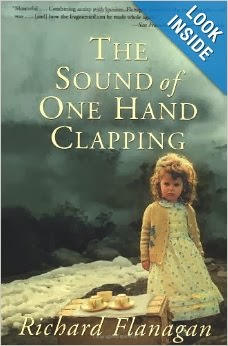
Book Revew- The Sound of One Hand Clapping


My First Read of 2014

A review of Richard Flanagan’s

The Sound of One Hand Clapping


            An Australian woman, a lover of books, wrote in glowing terms of reading a book by Richard Flanagan, and thinking something like “Here I have in my hands the book which might take the Miles Franklin Award and they all just want to watch the Bachelor.”  She was referring to a different book by Richard Flanagan, and the Miles Franklin Award, a prestigious literary award given for a “novel which is of the highest literary merit and presents Australian life in any of its phases.”  I had come to know of this Australian woman through Twitter and decided to try to find the book and failing to find it in America discovered how The Sound of One Hand Clapping was available.  I asked her about the book and she spoke of it as powerful and unsettling.  That it is.

            Somewhere as the past year morphed into a new year, another friend from Twitter posted a link to an article that said on average an American reads “0” books in a year.  The average American does not read a book in a year.  I had managed to do only slightly better than that last year, and over the years I have read only a few books a year, some years very few.  I wanted that to change, and so I decided to read at least fifteen pages a day from at least one book until I finished a book and started on another.  I hate to admit how many years I have passed without reading a novel, so I started by reading this one.  I am grateful for having been drawn to this choice.

            It is as my Australian acquaintance noted an unsettling novel.  It is a book which takes you inside the evolving lives and self-understanding of a father named Bujan Bulow and his daughter Sonja.  Their lives evolve not in chronological order but in the order of their memories as they gradually perceive who they are and how they fit into the world.  They don’t fit all that well but where there is life there is the possibility of a turning point in life.  There can be the turning point where one moves towards a downward spiraling descent towards self-destruction.  Or there may be a turning point where one begins to sense a meaning and purpose upon which a life may grow and take hope and be shaped towards the possibility of the future.

            The novel brings to life many of the modern issues, not in a preachy way but in the form of the human beings presented.  Faith is not central in the words describing it, but its possibility is hinted at in such a way that it is clearly not something merely peripheral to the human experience.  Bujan Bulow’s life is haunted by a past that included his being caught in the malaise of the World War II’s horrendous “Eastern Front.”  It is also shaped by his life as an immigrant, a wog, who lives in Australia but will never really be viewed as an Australian.

Flanagan masterfully connects the shaping power of suffering in life to the possibility of a horrendous cycle of ruined lives.  The cycle that began in wartime atrocities, generates haunted persons forming dysfunctional families, resulting in self-destructive vices and ruined self-perceptions that seem to further predestine a hopeless result for the future.  But still there is the human spirit capable of discovering revival and yet also fragile that a movement towards personal renewal can be so easily snuffed out by a single moment when the fragility of the human soul gives way and despondency overwhelms the desire for renewal.

            There is a sense in which Bujan Bulow’s life and the life of his daughter Sonja are inescapably connected and belong together.  Yet their stories are still distinct and individual.

            I don’t want to ruin the plot for you if you haven’t read it.  But one of the features I love in the book is how the book is written to promote a sense of the changing self-perceptions of how Bujan and Sonja perceive their lives.  Their self-identities are not shaped by mere chronological progressions.  The present is always shaped by the past, and yet the past is always remembered by the changing sense of the present, and the self-perception of both builds a sense of what can be accomplished and expected from the future.  So Flanagan takes us on a journey from the 1950’s to the very early 1990’s in which life goes back and forth, experiencing, remembering, expecting back and forth as self-perception is shaped, reshaped, and directed and re-directed.  This is how this novel becomes not just a book with a plot but an exploration of humanity.   A dismal past and a dismal present may create a fatalistic sense of total inability for one to hope or expect anything but more defeats and destruction for one’s own future.

That is part of the unsettling nature of this book.  For when one has no sense of hope, there is a perception that life is brutal, and if life is brutal then one survives only by learning to be hard and brutal.  How can one hardened and brutalized in life begin to take hope?  For one it might be a decision to stay somewhere and not to flee their unfolding life as they have always fled the struggles abounding in life.  For another it might be that however horrible the life of a wog, and the lives of fellow wogs might be, there is still something that one lowly wog can do to create a bit of beauty in life for another lowly wog.  So somewhere small there is a nearly imperceptible change, but that change is something that can be built on, that helps make the present meaningful, helps to remember the past differently, and creates a different possibility for the future.

            This is my first book finished in 2014.  It is an accomplishment to finish a book so early in the year.  I am grateful for the person who recommended it to me, for while it is true that this book can be deeply unsettling it can also be wonderfully glorious.  I count it a masterpiece, but I’m not a literary critic, just someone who happened to read a book that captured his imagination, his heart, and his soul.